Why does technical documentation quality stall despite heavy investments in new authoring tools? Evaluating content maturity requires mapping documentation systems onto three gardening archetypes: the unmanaged wasteland, the cultivated English garden, and the strictly structured French garden.
Enters content maturity mapping. Document quality depends on three synchronized factors: process, team ownership, and semantic content format.
1 · Wasteland
- Process
- No process
- Team ownership
- No owner
- Content format
- Inconsistent formats
2 · English garden
- Process
- Reliable process
- Team ownership
- Dedicated team
- Content format
- Consistent but unstructured format
3 · French garden
- Process
- Reliable process
- Team ownership
- Dedicated team
- Content format
- Structured, semantic format (DocBook, DITA)
Wasteland architecture
Unmanaged documentation lacks assigned ownership and standardized workflows. Authors produce disconnected files across arbitrary formats: a Word document in one folder, an unmaintained wiki page in another, and static PDFs exported years ago.
Wasteland ≠ bad writing: A wasteland isn’t defined by poor writing.
Accidental quality occurs when an engineer writes a clear guide during downtime. Without formal maintenance processes, single pages decay when products update.
Topic-based English gardens
An English garden introduces dedicated ownership and consistent authoring workflows. Content team members maintain unstructured or lightweight topics using predictable tools.
Cultivating topic-based content provides reliable user documentation without XML schema complexity. Maintaining unstructured Markdown files in Git repositories delivers high accuracy without structured authoring overhead.
Often enough on its own: For many teams, a well-maintained English garden is already far enough.
Structured French gardens
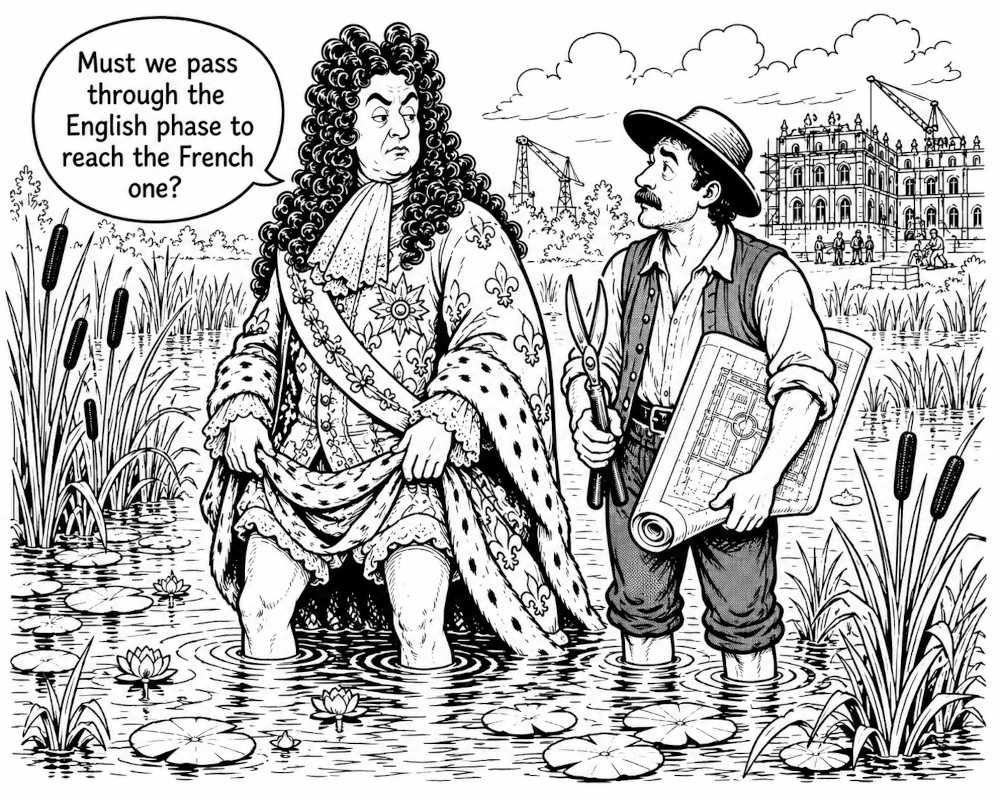
A French garden introduces strict semantic constraints: content elements conform to rigid DITA or DocBook schemas rather than desktop publishing layouts.
Separating semantic payloads (warnings, prerequisites, steps) from presentation stylesheets allows automated single-source publishing across multiple languages and channels.
- Semantic payloads (warnings, prerequisites, steps)
- Presentation stylesheets
- Multiple languages & channels
Component interdependence
Adopting structured DITA schemas without establishing process discipline creates an expensive XML wasteland. Each maturity level requires alignment across all three pillars, as the matrix above shows:
Maturity diagnostics
Diagnostic evaluation prevents premature migration to complex schemas:
- Establish process and ownership. Teams in a wasteland must do this before changing markup formats.
- Run a content audit. Measure current reuse requirements before committing to a DITA XML migration.
Related reading
- The three levels of technical documentation: the maturity model in reference form.
- Structured and unstructured formats: what makes a format semantic.
- KISS Principle of Simplicity: why restraint should govern each step up.