Persona prompting: you’re an experienced typographer, check this before printing
Two prompts, one PDF
A PDF is ready for final review. It’s been through twenty commits of typographic iteration. The layout is stable. The question is whether anything was missed.
Ask that question two ways.
Version 1: “Is this PDF well laid out?”
Version 2: “You’re an experienced typographer. Check this PDF before printing.”
Both prompts go to the same model, with the same PDF attached. The outputs aren’t the same.
What the vague prompt returns
“Is this well laid out?” tends to return validation with caveats. The model reads the PDF, identifies that the layout follows standard conventions, and produces a response structured around what is working, which, after twenty commits of careful iteration, is most things. The caveats exist, but they’re phrased tentatively: you might consider, it could be worth checking, some readers may find.
This is useful in the same way that a polite peer review is useful: it confirms you haven’t made any egregious errors. It doesn’t give you a list of things to fix before you go to press.
The problem isn’t the model’s capability. It’s the frame. “Is this well laid out?” is a yes/no question with an implied preference for “yes.” The model answers accordingly.
What the persona prompt returns
“You’re an experienced typographer. Check this PDF before printing.” changes the implicit contract. An experienced typographer reviewing a file before printing isn’t looking for reasons to validate it. They’re looking for problems. They have a professional standard they’re applying. They’re accountable for what gets through.
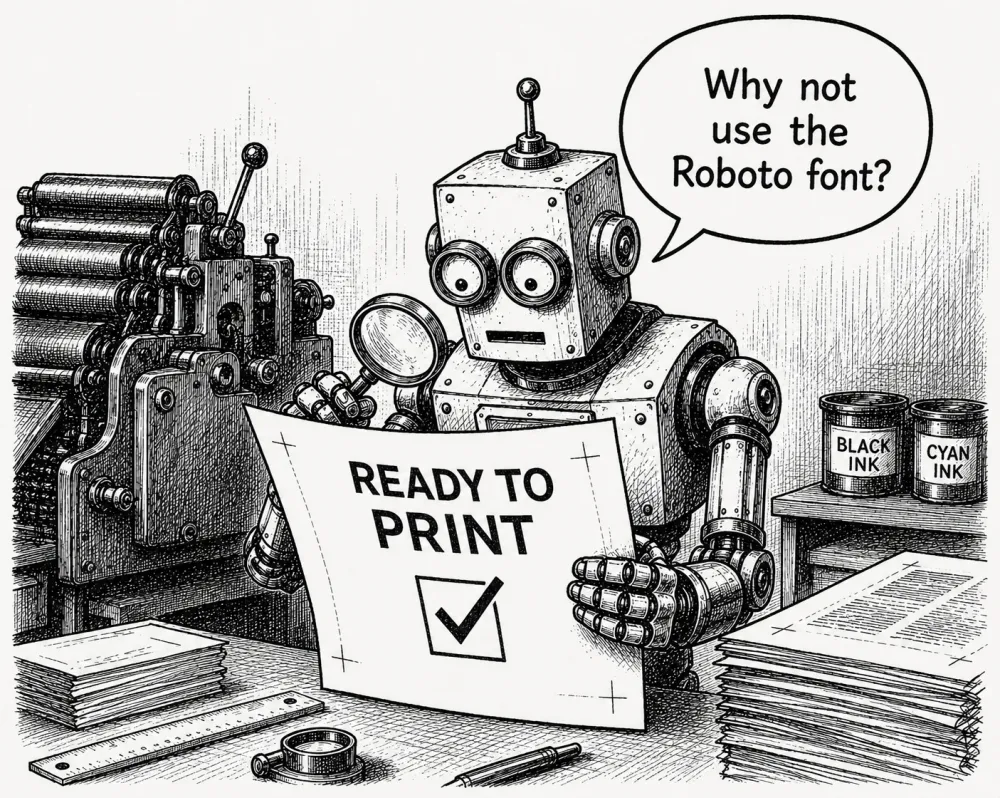
The review that came back from this prompt was structured, technical, and actionable. The summary: “very good quality: sober, consistent, clearly done by someone who masters book typography. No blocking issues.” But the substance was in the specifics:
- The Garamond/Cormorant small-caps pairing was called out as “coherent and refined, suited to long-form reading”
- The title sheet (the structured header opening each commentary) was flagged as “a distinctive and well-executed design element”
- Three action items came back: run a widows/orphans pass across all 136 pages; check QR code positioning on longer titles; tag the PDF for digital accessibility if an accessible edition is ever produced
These are not vague suggestions. They’re a pre-press checklist. They came from the same model that would have returned polite validation had the prompt been phrased differently.
Macro inspection and line-numbered proofing
An automated or AI review gives you a list of potential defects, but verifying them across 136 pages still requires human eyes on the layout. Scrolling page by page in a viewer makes you lose the sense of pacing and spread balance.
Two proofing targets bridge the gap:
- Imposition contact sheets: Using
pdfjam, the pipeline renders all 136 pages into 4×4 sheets (make chemin-de-fer-tome1) or a single-page 15×10 overview (make chemin-de-fer-tome1-1page). This puts the entire visual landscape on one surface, making it easy to spot uneven gray values, awkward spread breaks, or floating chapter openers at a glance. - Line-numbered proofreading builds: For human collaborators, running
make revolution-relecturecompiles an edition with per-page line numbers (lineno pagewise). Reviewers can cite exact line and page coordinates rather than describing where a typo or bad break sits.
The mechanism
The persona does two things. First, it establishes a role that carries implicit knowledge and standards. An “experienced typographer” knows about widows, orphans, rivers, bleed zones, PDF tagging, and the specific failure modes that appear in print but not on screen. The model populates that role from its training. The prompt doesn’t need to list these concerns: the role implies them.
Second, it establishes a purpose: checking before printing, not evaluating in the abstract. This orients the review toward actionable pre-press findings rather than general aesthetic assessment. The framing cues the model to produce output that functions as a checklist rather than a critique.
What this generalises to
The persona technique works wherever the task has a natural expert role attached to it. “You’re an experienced security engineer, review this authentication code before it ships” produces a different review than “is this authentication code good?” The role brings the standards; the purpose brings the orientation.
The key is specificity. “You’re an expert” is marginally better than nothing. “You’re an experienced typographer checking a PDF before a print run” is substantially better, because the role and the task together activate a specific cluster of knowledge and a specific evaluative frame.
It’s also worth noting what the technique doesn’t do. It doesn’t make the model infallible. The review may miss things; the three action items it returned may not be the three most important items. The technique improves the signal-to-noise ratio; it doesn’t guarantee completeness.
There’s a sharper risk worth naming, because it’s the flip side of what makes the technique work. The persona changes the register of the output, not just its accuracy. “You’re an experienced typographer” produces findings that sound like an experienced typographer wrote them (confident, specific, couched in the right vocabulary) whether or not they’re correct. The same framing that surfaces a real widows-and-orphans problem will, on another file, invent a plausible-sounding concern in exactly the same authoritative voice. Persona prompting raises the floor on usefulness and the ceiling on persuasiveness at once, which means it also raises the bar for verification: a wrong finding delivered in expert register is harder to dismiss than the same error hedged with “you might consider.” The technique is most dangerous precisely where it’s most useful: when you don’t have the domain baseline to tell a correct expert-sounding finding from an incorrect one. The persona makes the model a better-sounding reviewer. Whether it made it a better reviewer is something only the reader’s own judgment can confirm.
The practical test is comparison: does the persona-framed prompt consistently return more actionable output than the open-ended version? In this project, the answer was clearly yes. Enough to make it the default prompting approach for review tasks.
Summing up
- The frame decides the answer. “Is this well laid out?” is a yes/no question with an implied “yes”; the same model, same PDF, returns polite validation instead of a fix list.
- The persona changes the contract. “You’re an experienced typographer, check this before printing” orients the model toward problems and a professional standard rather than abstract approval.
- The persona does two things. A role carries implicit knowledge and standards (widows, orphans, bleed, tagging); a purpose (checking before press) orients the output toward an actionable checklist.
- Specificity is the lever. “You’re an expert” barely helps; role plus concrete task activates a specific cluster of knowledge and a specific evaluative frame.
- It generalises to any expert task. Security review, code review, copyediting: the role brings the standards, the purpose brings the orientation.
- It changes register, not just accuracy. A wrong finding delivered in confident expert voice is harder to dismiss than the same error hedged, so the technique raises the bar for verification.
- It’s most dangerous where it’s most useful. Without the domain baseline to tell a correct expert-sounding finding from an invented one, you cannot trust the register the persona produces.
External sources
- Prompt engineering and role/persona prompting
- Anthropic prompting documentation
- A concrete pre-press defect the review flags
Related posts
Follow on LinkedIn for more
Articles on docs-as-code, DITA XML, YAML, and AI-assisted documentation.