# 1.8 million words, freed from Word 97 and made searchable
We’ll explore how to **leverage a corpus of 1,800 articles (~1.8 million words, comparable in volume to *A Song of Ice and Fire*)** to build an **AI-driven discovery platform** that makes reading, exploration, and print publication smarter and more meaningful.
1,800
Oral lectures
~1.8M
Total words
37
Legacy Word files
The central challenge is not merely searching text, but transforming a monumental chronological archive into a living knowledge base:
## Objective: building an AI-enabled knowledge platform from 1,800 articles
The goal is to transform a vast, heterogeneous collection of articles into a **structured, AI-enabled knowledge platform**.
Organize the heterogeneous archive into 1,800 clean, version-controlled Markdown files with standardized YAML frontmatter.
Enrich each lecture with thematic tags, Gaussian-normalized relevance scores, full-text indexation, and vector embeddings.
Enable conversational exploration, terminology clarification, contextual reading recommendations, and automated print curation.

Structuring a vast corpus: metadata, tags, and classification transform static text files into an organized knowledge system.
> **The editorial principle:** Make historical articles discoverable and approachable without losing the depth, subtlety, or authentic voice of the original teachings.
The end-to-end system architecture spans five connected layers:
---
## Analysis and cleaning
Before AI can meaningfully process the corpus, the data must be **clean and consistent**:
- **Deduplication:** Identify repeated articles and remove redundant content across files.
- **Formatting normalization:** Standardize headers, timestamps, and text encoding.
- **Quality checks:** Flag incomplete or corrupted articles for human review.
- **Consistency enforcement:** Align style, terminology, and structural headings for machine readability.
> **Infrastructure before AI:** AI does not magically fix poor data quality. Cleaning and normalization form the indispensable foundation for reliable metadata, dependable indexing, and trustworthy AI interaction.
---
## Metadata and tagging
Metadata transforms a large corpus into a **discoverable and analyzable knowledge base**:
Generate titles, meta descriptions, and keyword sets optimized for search engines and web-based exploration.
Automatically assign pedagogical themes: meditation, cause and effect, lineage, training, and daily life.
Assign interest scores and thematic relevance indicators based on user priorities and contextual intensity.
Insert cross-references, summaries, and definitions for technique-related terminology to improve searchability.
AI assists here by reading each article and suggesting thematic tags or highlights while maintaining consistency across the entire collection.
---
## Indexing and search
A robust indexing system enables **fast, accurate retrieval**, moving progressively from exact matches to conceptual connections:
- **Full-text search:** Index content to allow keyword-based queries across 1,800 texts.
- **Thematic navigation:** Enable filtering by topics, scores, or temporal context.
- **Semantic search:** Use embeddings or vector search to capture meaning beyond exact keywords, letting users find related concepts even if phrased differently.
- **Cross-linking:** Automatically connect related articles to create a **web of knowledge** that mirrors article interconnections.
This ensures that users can **explore the corpus efficiently**, whether seeking a specific lesson or discovering related concepts.
---
## Interactive AI layer
The AI layer transforms static content into an **intelligent, interactive discovery platform**:
Suggest articles or themes based on user interests or previous reading paths.
Summarize complex teachings or provide background on lineage and philosophical terminology.
Allow users to ask questions, clarify concepts, or explore nuances dynamically.
Generate summaries, highlight patterns, and identify frequently referenced masters or concepts.
> **Preservation of integrity:** The original lecture transcripts remain intact and untouched. AI-generated metadata, embeddings, and summaries serve strictly as an enrichment layer to guide readers back to the source text.
---
## Deploying the AI discovery platform for web and API access
Finally, the platform is designed as an extensible content platform rather than a collection of one-off scripts:
- **Web interface:** User-friendly dashboards for browsing, filtering, and exploring articles.
- **API access:** Allow other applications or AI systems to query the corpus programmatically.
- **Scalability:** Ensure smooth operation even as new articles or supplementary materials are added.
- **Preservation of integrity:** Maintain original text alongside enriched metadata to honor the authenticity of the articles.
---
## Automated thematic scoring of Markdown files with GPT
We can use a Python script to automate the evaluation and enrichment of Markdown files by assigning a **semantic score** related to any theme, for instance, *daily life*.
The scoring process operates in three explicit stages:
### 1. AI-based Evaluation
Each `.md` file is read and sent to an OpenAI model. The model assigns a raw score from **1 to 10**, estimating how strongly the text relates to the target theme.
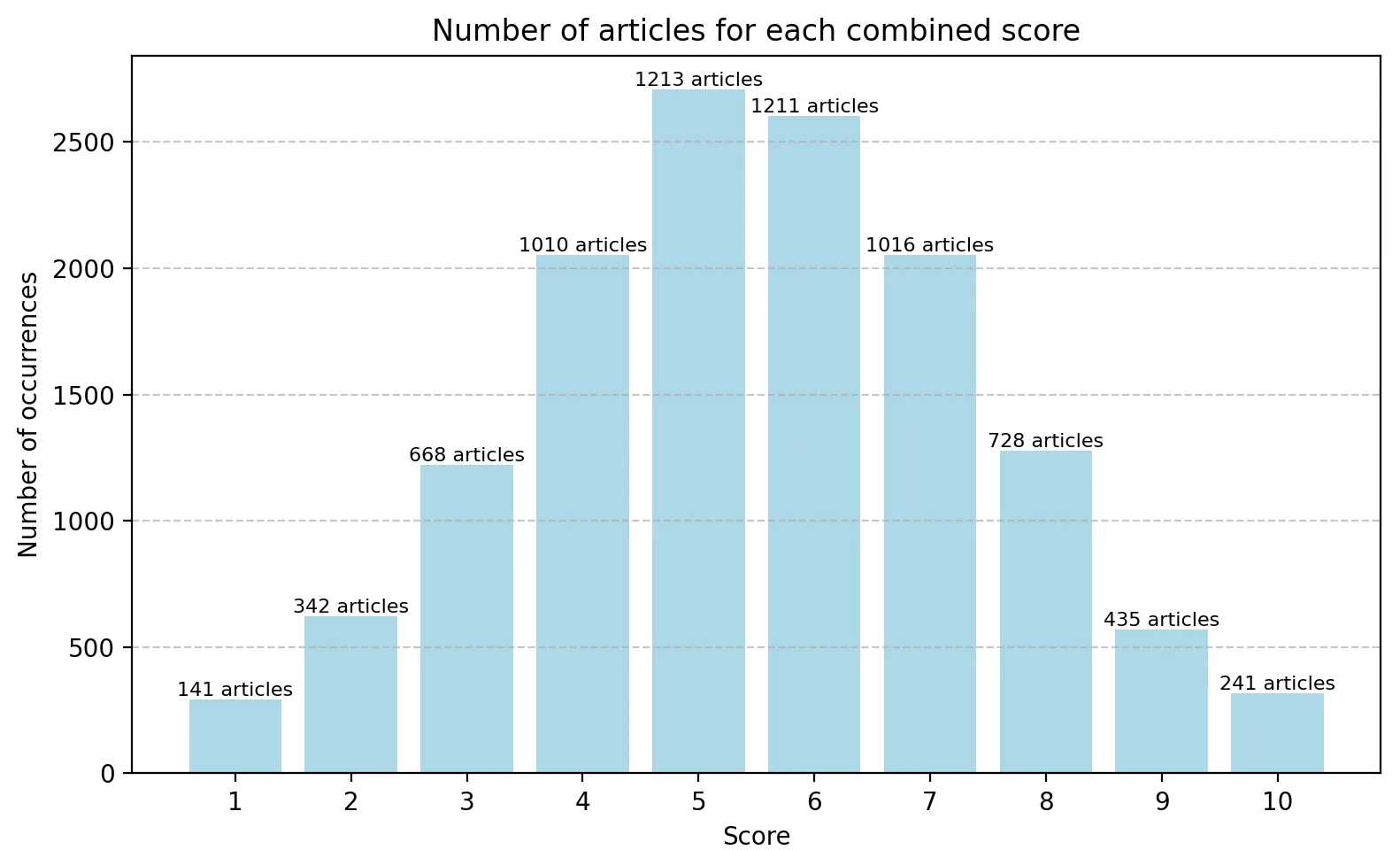
Distribution of articles across combined scores, normalized as a Gaussian curve to spread values evenly across the 1–10 range.
### 2. Gaussian Normalization
To ensure a smooth and realistic distribution of results, the raw scores are rebalanced using a **Gaussian (normal) curve**, spreading the final values evenly across the 1–10 range. This avoids clusters of identical scores and makes large-scale data more insightful.
> **Normalization vs. underlying truth:** There's no law that thematic relevance is normally distributed: for a corpus built around core themes, it may genuinely be bimodal or heavily skewed. Forcing raw scores onto a bell curve spreads them out for browsing, but it manufactures gradations that may not exist and flattens real clusters. Normalize for presentation, but keep raw scores too: the raw distribution reveals the true density of the corpus.
### 3. Frontmatter Update
The script then writes the final score back into each file’s **YAML frontmatter** as a new or updated field.
**Example: AI-generated metadata record**
The metadata for this article was generated from an AI-assisted analysis of hundreds of articles. By identifying recurring themes of awareness, balance, and mindful attention, the AI distilled key insights into how stillness can nurture clarity and calm in everyday life:
```yaml
title: The Power of Stillness – Deepening Awareness Through Mindful Sitting
sourceLanguage: en
description: Explore how mindful sitting cultivates presence, clarity, and balance in everyday life through sustained attention and inner calm.
lastUpdated: 2009-10-31T11:00:00Z
wordCount: 1586
keywords:
- Mindfulness
- Meditation
- Awareness
- Focus
- Presence
- Inner Calm
- Clarity
- Balance
- Attention
- Well-being
interest_score: 10
daily_life: 8
mindful_posture: 8
intentional_action: 7
continuity_of_practice: 10
```
> **From text file to structured record:** Each article remains readable Markdown, but now carries machine-readable keywords, timestamps, word counts, and multi-thematic scores that power programmatic curation.
---
## From Markdown to LaTeX: automating the creation of various anthologies
> **The curation problem:** No one could realistically read 1.8 million words of articles in print: even a skilled reader would need about 120 hours—roughly two full weeks of non-stop reading—to get through them all. Since the full corpus is available online, the real challenge is curation: selecting and assembling themed anthologies tailored to reader interests.
A Python script automates the **conversion and assembly of Markdown articles into a single, beautifully formatted LaTeX book**, ready to compile with *XeLaTeX* or *LuaLaTeX* on Overleaf.
It performs the entire workflow in three stages:
1. **Markdown Cleaning and Conversion**
Given a Markdown file, the script extracts its title from the YAML frontmatter, removes HTML markup and Markdown links, and converts the text into **LaTeX** using *Pandoc*. Each `.md` file becomes a clean, self-contained `.tex` chapter with a proper `\chapter{Title}` heading.
Generated LaTeX PDF excerpt demonstrating automated typography, running headers, and A5 book layout curated directly from Markdown files.
2. **Chapter Management**
Every generated chapter file is recorded in a hidden list (`.chapters_list.txt`). This ensures that chapters are automatically tracked and appear in the correct order when the book is rebuilt.
3. **Book Assembly**
The script then reconstructs a master file, `main.tex`, combining a custom-themed LaTeX preamble (Garamond typography, A5 format, glossary of technique-related terms), `\input{}` references for each chapter, and a closing section with a glossary of keywords.
> **Engineering meets craftsmanship:** The automation does not replace book design. It bridges editorial selection and typography, compiling hundreds of standalone Markdown files into unified, publication-quality physical volumes.
---
## Outcome: a scalable AI-powered publishing platform for deep reading
The result is a unified platform where one structured corpus powers two complementary discovery and publishing streams:
Full-text indexing, multi-thematic filtering, vector embeddings, and an interactive conversational assistant for continuous online exploration.
Automated threshold selection, deduplication against published books, Pandoc chapter conversion, and LaTeX compilation into elegant A5 print anthologies.
Readers are offered a way to **rediscover meaningful content** through both **digital exploration and carefully crafted print editions**, bridging technology and editorial quality. To see how this same corpus becomes a living daily knowledge flow, read [transforming a corpus of 7,000 pages into living knowledge](https://redaction-technique.org/transforming-corpus-ai-living-knowledge).
## Summing up
## External sources
- [Pandoc: Word->Markdown->LaTeX conversion](https://pandoc.org/)
- [Embedding-based discovery](https://en.wikipedia.org/wiki/Semantic_search)
- [Vector search beyond keywords](https://en.wikipedia.org/wiki/Word_embedding)
*Hero image: ["DSC_6638: Open wooden doors revealing the interior of a bright Buddhist temple hall with a golden Buddha statue inside."](https://www.flickr.com/photos/pattayapatrol/54205291143) by [Pattaya Patrol](https://www.flickr.com/photos/pattayapatrol/), licensed under [CC BY-SA 4.0](https://creativecommons.org/licenses/by-sa/4.0/).*
---
Source: https://redaction-technique.org/transforming-meditation-classes-ai-discovery